THE HOTZONE Ep. 2 "Anti Cheat": how 185,000 cheaters got banned
Joe, Lee, Howard and Tim spend just under an hour explaining how Bulkhead detects cheaters, why the big ban wave took so long and what comes next.
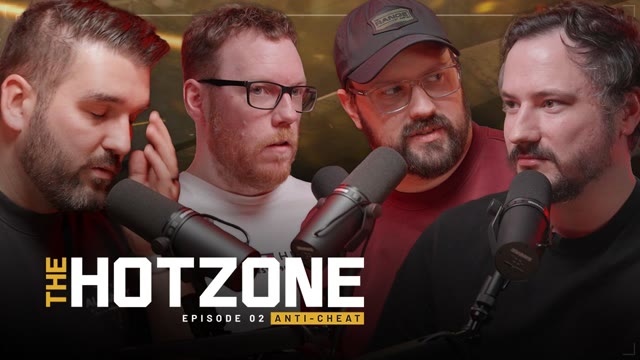
The second episode of THE HOTZONE (58 min) is all about cheating. Joe (Studio Lead), Lee (Lead Core Tech Programmer), Howard (community and UX) and Tim (Creative Director) recorded it shortly before the big ban wave. They hold back details on purpose, and anything marked undecided is not a promise.
🔴 TL;DR: cheating, bans and what comes next
- Ban wave → 185,000+ accounts, close to 5% of all buyers. More accounts than the game has Steam reviews (~150,000).
- How they catch cheaters → A case file per player: hardware-level mouse input compared with server data, telemetry, reports, and a replay of every session since about the start of Season 2.
- False bans → Rules are tested as "simulated bans" and checked by hand. They put their confidence at 99.8–99.9%.
- Auto clickers and macros → Not a ban on their own, but detected and counted as a flag. Advice: don't use them.
- Farming and RMT servers → Accounts wiped; exploiting and farming now means a permanent ban.
- Smurfs → Second accounts are banned too, in both directions ("digital bloodline").
- 🔴 Trust score → Server admins set a minimum score. Secure Boot, TPM and an optional ID check raise it. Details not final.
- AI → Used for code, tools and data analysis, not for art, animation or voice.
The ban wave
The numbers. 185,000+ accounts on nearly 4 million copies sold. In Season 1 they only banned about 10,000, which is why the game felt full of cheaters while roughly 5% of players were cheating.
Why so late. All three of their anti-cheat providers told them: every studio can ban, most are afraid to. They first needed a baseline of what normal play looks like. The plan was two years of data collection; with about 4 million players in roughly 60 days it went much faster. They say Season 1 and the rushed Season 2 suffered because the team was busy "firefighting" cheaters.
A gamble. Joe says it could backfire if the story becomes "they ban innocent players". Banned players can still write Steam reviews, so they ask everyone else to leave an honest one.
How they catch cheaters
- Input vs. server. What your mouse did at hardware level is compared with the hits and kills the server recorded.
- Replays. A tool they jokingly call "Hilfiger" replays any session. New rules run as simulated bans first, and around 50 affected accounts are watched by hand.
- Headshot rate. Early cheaters were at about 80%, then turned it down; through Season 2 most sit at 24–36%. The best players, Shroud included, are at about 12%.
- Behaviour. Crosshair briefly locking through buildings or onto a driver, pre-aiming at hilltops, reloading while staring at a wall, running into the open right after a kill.
- Case file. One odd moment is not a ban; the same thing fifteen times is. Reports don't ban, but they push an account up for checking.
- 🔴 One admitted mistake: a day-one mass ban caused by a network card without a unique ID (manufacturer error), since corrected.
Auto clickers. The standard excuse after a ban. Their position: an auto clicker alone isn't a ban, but it is a flag in your file. In the example they walk through, the real reason turned out to be a triggerbot.
No public discussion of bans. Every confirmed excuse ends up on cheat forums as a template, so they don't comment on individual cases.
Who cheats
Regions. "It's the Chinese players" is not what the data shows. Share of cheaters among buyers: Africa about 12%, South America about 8%, then Europe, then China. In absolute numbers most come from Europe and China.
Farming servers. The exception: highly organised farming and RMT servers with staff, rules and fixed rotations of revives, spotting and kills. The devs show themselves joining one, wiping cash and XP, ending the match and banning everyone. Season 1 brought warnings; now it's permanent.
Smurfs. They made over a million dollars from cheaters re-buying the game. Second accounts are now banned by hardware ID, and a ban on a throwaway account also hits the main account.
Why WARDOGS is harder to protect
- Too much was decided on the player's PC in Season 1 to save server performance; this is being moved to the server.
- No fixed lanes as in Valorant, so "unusual" is harder to define.
- One cheater affects 99 other players, not nine.
- Many suspected cheaters turn out to be normal mortar teams.
What comes next
🔴 Trust score. Everyone starts with a score (in their example 100). Admins and Bulkhead set a minimum per server; high-trust, low-trust and no-trust servers are possible. Secure Boot and TPM raise the score. Suspicious accounts can be required to turn them on. Possible later: lowering a score instead of banning.
ID check (being investigated). Through the outside service Play Safe ID, which only passes on a token. They say they will never force it.
Secure Boot and TPM alone don't help. Around 80% of the cheats they see get past them. With Valorant-level requirements they'd lose about 60% of players. The growing problem is DMA hardware.
Subscription (Joe's personal idea, not a plan). It would help anti-cheat but price out players in poorer regions.
No promise. "We're never going to fix cheating." Cheaters will get through again and be banned in waves.
AI in development
- Used for programming, tools and data dashboards, including anti-cheat. Not for art, animation or voice.
- Their claim: every studio uses more AI than it admits.
- Cheat makers get working code from AI models without anyone stopping them, so the studio says it has to keep up.
- 80–90 people run a game that peaked at 420,000 players. They say they are not replacing staff.
Written up from YouTube's auto-generated captions, so names and numbers may be slightly off. The team itself calls a lot of this "raw" and not final.